


Let’s talk about Southern Italy for a summer abroad, including Naples, the Amalfi Coast, Puglia, and the islands of Sicily and Sardina.
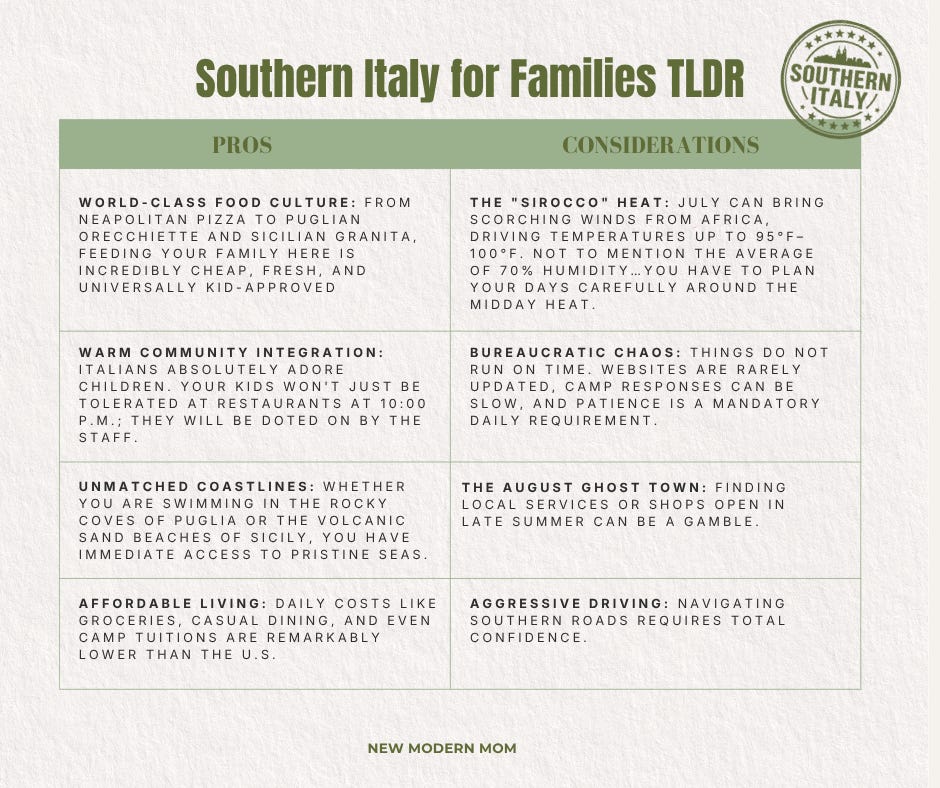
There is only one reason I personally haven’t seriously considered this region: Southern Italy in July is hot. Relentlessly hot. You have to go into this experience knowing and expecting Mediterranean sun that slows everyone down. I’m originally from Dallas and recall every single summer growing up being miserably hot… hopping from pool to A/C to lake on rotation. That’s not me. But if you love a good toasty day, keep reading…
The positive tradeoff is that the heat is exactly what forces the region into its slow-paced lifestyle. Because it’s too hot to rush, you’re practically required to trade the frantic pace of American life for a late-afternoon riposo (siesta), long sea days, and a lifestyle centered around the evening hours. Moving here means stepping away from highly curated tourist spaces and sliding into the authentic, slow, and sun-drenched ways of the Southern Italians.
Logistics: Getting There & Staying There
Ease of Getting There:
Campania: Fly into Naples International Airport (NAP), which is highly central and just a 15-minute taxi ride from the historic center.
Puglia: Use Bari Karol Wojtyła Airport (BRI) or Brindisi Airport (BDS) depending on which side of the coast you base yourself.
Sicily: Fly into Palermo Falcone-Borsellino (PMO) for the western side of the island or Catania-Fontanarossa (CTA) for the east.
Sardinia: Fly into Olbia Costa Smeralda (OLB) or Alghero Fertilia (AHO) if staying on the northern side of the island or Cagliari Elmas (CAG) for the far south.
Flights: Seasonal direct flights from the East Coast straight into Naples and Palermo are common. If you are flying from the West Coast, it’s going to be a long travel day(s). And expect big delays if flying an Italian airline.
Getting Around: Stroller vs. Scooter Realism
The Stroller: You need a highly compact, lightweight travel model with durable wheels. A baby or toddler carrier is way easier.
Kid Scooters: Leave them at home.
Is a Car Necessary?
Naples: No. Use the Metro and regional trains (like the Circumvesuviana) for day trips.
Puglia & Sicily: Yes, absolutely. If your camp is in Siracusa, Trapani, or the Puglian countryside, you cannot survive without a rental car.
Sardinia? Yes, absolutely. While you can manage without one in main city hubs like Cagliari, you cannot manage a summer camp routine or explore the island without a car.
Housing:
Naples: A 2-bedroom in a family-safe, upscale neighborhood like Vomero or Posillipo ranges from $2,700–$5,000/month.
Sicily: High-end coastal apartments in Palermo (Mondello area), Trapani, or Siracusa (Ortigia) have a large range from $2,400–$4,000/month in July.
Puglia: A central apartment in Bari or a traditional country house (masseria) further south in Brindisi ranges from $3,000-$7,000/month.
Sardinia: In the ultra-exclusive Costa Smeralda (Porto Cervo/Porto Rotondo), expect high-season July rates of $4,500–$8,500/month. If you look slightly further south to San Teodoro, or west to Alghero, apartments range from $2,500–$4,500/month.
The “American Reality” Check:
Air Conditioning: This is an absolute dealbreaker. Do not trust descriptions that say “naturally cool stone walls.” You must explicitly verify that your rental has high-functioning A/C in every bedroom.
Laundry: Washers are standard, but you will be hanging your laundry on a drying rack on the balcony.
The “Riposo” (Siesta): The region shuts down completely between 1:30 p.m. and 4:30 p.m. Grocers, shops, and restaurants close so everyone can escape the heat.
Trash Management: Southern Italian cities, particularly parts of Naples and Palermo, struggle with public waste management. It can be jarring for American families. Focus your housing searches on residential, upscale neighborhoods to minimize this.
The Weather: What to Expect in July
The Temperature: Expect daily highs ranging from 85°F to 93°F in Naples, while Puglia and inland Sicily can easily climb to 95°F–100°F during a heatwave.
The Evening Vibe: The entire community revives after 7:30 p.m. when the sun goes down and a cooler sea breeze rolls in.
The Southern Italy Food Scene & Typical Schedule
What to Eat:
Pizza Napoletana (Campania): Wood-fired, soft, and simplistic.
Panzerotti & Taralli (Puglia): Fried dough pockets filled with tomato and mozzarella, and crunchy savory seed rings.
Granita con Brioche (Sicily): Semi-frozen fresh fruit or ice served with a warm, fluffy sweet bun.
Pane Carasau (Sardinia): A paper-thin, incredibly crispy flatbread. Drizzled with local olive oil and sea salt (called Pane Guttiau).
Street Seafood: Paper cones packed with fried calamari and small local fish bought fresh by the harbor.
Typical Eating Schedule:
Lunch: 1:00 p.m. – 2:30 p.m. The main meal of the day before the afternoon shutdown.
The “Merenda”: 5:00 p.m. The late afternoon snack, usually gelato or fruit, to hold everyone over until a late dinner.
Dinner: 8:30 p.m. – 10:30 p.m. Restaurants rarely even open their doors before 8:00 p.m.
Things to Do With Kids
The Ruins of Pompeii & Herculaneum (Campania): Walk through real ancient Roman cities frozen in time. Opt for Herculaneum with younger kids. It’s smaller, better preserved, and offers more shade.
Family Pizza Making Class (Campania): Book a workshop in Naples where master pizzaioli teach kids how to stretch the dough, throw on fresh toppings, and watch it rise in a wood-fired oven.
Città della Scienza (Campania): This is a massive, hands-on science museum featuring a great interactive planetarium and a museum dedicated entirely to the human body.
Puppet Theatre / Opera dei Pupi (Sicily): Take the kids to a traditional Sicilian marionette show.
Mondello Beach Day (Sicily): Spend a classic day renting umbrellas and chairs on the white sands of Mondello.
Bioparco di Sicilia (Sicily): A zoo and botanical garden that features life-sized dinosaur models hidden along the garden paths.
Syracuse Boat Tour (Sicily): Rent a small boat from Ortigia island to explore sea caves and swim in crystalline water.
Zoosafari Fasanolandia (Puglia): One of the largest drive-through safari parks in Europe.
Grotte di Castellana (Puglia): Escape the sweltering July heat by exploring this massive, spectacular underground cave system that stays a cool 65°F year-round.
Sardegna in Miniatura (Sardinia): This interactive park features 1:25 scale models of the island’s landmarks, a planetarium, and an outdoor dinosaur park with life-sized, moving prehistoric creatures.
La Maddalena Archipelago Boat Tour (Sardinia): Charter a boat or hop on a catamaran from Palau to cruise the protected islands. The waters are shallow, completely translucent, and calm. It’s perfect for kids to safely snorkel or jump off the boat into the natural swimming pools.
Things to Do Without Kids
Sunset Cocktails in Positano (Campania): Take a high-speed ferry from Naples to the Amalfi Coast for an evening of coastal views and upscale dining away from the city.
Wine Tasting on Mount Etna (Sicily): Take a day trip to taste high-altitude, volcanic Nerello Mascalese wines.
Explore Lecce’s Baroque Architecture (Puglia): Known as the “Florence of the South,” spend a late night wandering through illuminated limestone cathedrals and boutiques.
Dinner in a Puglian Grotta (Puglia): Book a romantic dinner overlooking the Adriatic Sea inside a naturally carved limestone sea cave at Polignano a Mare.
Sunset Sea Serenade in Cagliari (Sardinia): Rent a private sailboat to cruise around the cliffs of the Sella del Diavolo (Devil’s Saddle) at sundown, pairing a local Vermentino wine tasting with traditional Sardinian charcuterie.
Agriturismo Dining in the Barbagia Interior (Sardinia): Book a dinner at a traditional agriturismo (working farm restaurant) where island dishes are cooked slowly over open fires.
Local Support
Sitly.it: The primary, highly active platform in Italy for finding local university students and babysitters.
Babysits.it: Excellent for sourcing English-speaking or international caregivers, particularly in hubs with international schools like Naples, Bari, and Palermo.
Average Rates: Incredibly budget-friendly compared to northern Europe. Expect to pay €8–€15/hour, with the higher end reserved for native English speakers or specialized baby care.

The Southern Italy Summer Camp List
I’ve found 10 super fun camps for ages 18 months to 14 years old!