


Italy is high on my list for an extended summer in Europe, mostly because there is so much variety. But the reality of a Mediterranean summer is that the heat can be intense, especially in the south. As dreamy as Southern Italy sounds, hundred degree afternoons can make it hard to actually enjoy the beaches and piazzas.
That is what makes Northern Italy feel so special. From the Dolomites to Lake Como to Milan, it offers a more livable summer with cooler temperatures and just as much charm.
The Dolomites are still at the very top of my personal list for living abroad in the summer. We tried to make it happen last year, but finding legitimate day camps for the kids and good housing options was surprisingly hard. That experience is a big part of why I started creating these guides and co-created Roam Collective, to make these kinds of stays feel more possible for families like ours.
This list is for anyone dreaming of an Italian summer that feels beautiful, inspiring, and actually doable with kids.
Logistics: Getting There & Staying There
Ease of Getting There:
Major Airports: Land in Milan Malpensa (MXP) for the lakes/Dolomites, or Venice Marco Polo (VCE) for the eastern region.
Flights: Several major U.S. cities offer seasonal non-stop flights to Milan and Venice, mostly from the East Coast. If you’re flying from the West Coast (Los Angeles, San Francisco, etc.), expect 1-2 stops.
The Commute: Reaching the camp hubs varies. Milan is a 50-minute train from Malpensa. Padua and Venice camps are within 30-45 minutes of the VCE airport. For the Dolomites, expect a 2.5-hour drive from Venice or Milan.
Getting Around: Stroller vs. Scooter Realism
The Stroller: In cities like Milan or Padua, a standard stroller is fine. In Venice, strollers are a nightmare due to the endless bridges; baby-wearing is your only sane option.
Kid Scooters: Great for the flat parks of Milan or the lakeside promenades of Garda. Not recommended for the steep mountain villages of the Dolomites.
The Train: Italy’s Frecciarossa (high-speed train) is the best way to move between Milan, Bologna, and Venice. It’s clean, fast, and very family-friendly.
Cost of Living & Rentals:
Housing: A 2-bedroom apartment in a family-friendly area like Brera in Milan or near the parks in Padua ranges from $3,200–$5,500/month in July. Lakeside villas and Dolomite chalets can skew much, much higher.
A Note on Venice Housing: Finding long-term stays on the island is a unique challenge; expect to pay a premium ($4,500–$7,000+) for a 2-bedroom. For better value and easier logistics, many families look at Giudecca (quieter/local) or Lido (beach access and actual space for kids to run).
The “American Reality” Check:
Air Conditioning: More common in Milan and Genoa, but often non-existent in mountain chalets. Usually, the mountain air is enough, but always verify “Aria Condizionata” if you’re heat-sensitive.
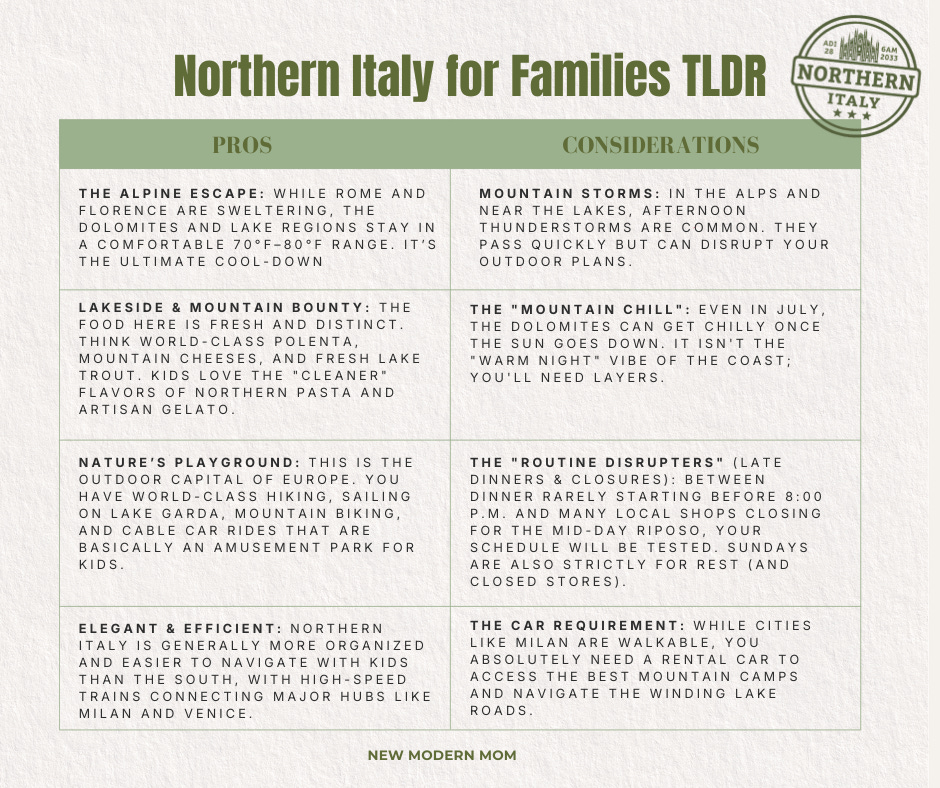
The Riposo: Shops and many restaurants close between 12:30 p.m. and 3:30 p.m. It is the mandatory Italian nap time.
Laundry: Standalone dryers are very rare. You’ll be using the “stendino” (drying rack). In the dry mountain air, things dry fast!
The Weather: What to Expect in July
The Temperature: In the cities and plains (Milan, Padua, Bologna), expect highs between 85°F and 90°F with higher humidity than the coast. In the Dolomites and Lake regions, the daytime is a perfect 75°F–80°F, though the mountain sun is incredibly intense.
The Evening Vibe: City nights stay warm. In the mountains, the temperature drops quickly after sunset to the 50s or 60s.
The Northern Italy Food Scene & Typical Schedule
What to Eat:
Risotto & Polenta: Northern Italy swaps heavy tomato sauces for creamy rice and cornmeal. Kids love the “simple” butter and parmesan versions, while parents can dive into the rich saffron-infused Risotto alla Milanese or mountain Polenta topped with melted fontina cheese.
Cotoletta alla Milanese: The ultimate kid-friendly staple. It’s a thin, breaded, and pan-fried veal or chicken cutlet, essentially the world’s most elevated chicken finger.
Pesto Genovese & Fresh Pasta: In the Northwest (Liguria), the pesto is bright, fresh, and hand-crushed. Pair it with trofie or trenette pasta; it’s a vibrant, healthy, and high-energy meal that kids actually get excited to eat.
Speck & Mountain Cheeses: From the Dolomites down to the lakes, the charcuterie boards feature smoky Speck (cured ham) and mild Asiago or Taleggio cheeses. These are perfect for a “grazing” lunch during a hike or a day on the boat.
Typical Eating Schedule:
Lunch: 12:30 p.m. – 2:00 p.m.
Aperitivo: 6:30 p.m. – 8:00 p.m. (The ultimate Northern Italian ritual; many bars offer a buffet of snacks with your drink).
Dinner: 8:00 p.m. – 10:00 p.m. Northern Italians tend to dine slightly earlier than the south, but 8:30 p.m. is the “sweet spot” for a lively atmosphere.
Things to Do With Kids
Dolomites: Take the cable car up to Alpe di Siusi. It’s the highest alpine meadow in Europe and basically a giant, safe playground with cows and easy hiking trails.
Lake Garda: Visit Gardaland. It’s Italy’s version of Disneyland and located right on the lake.
Milan: The MUBA (Children’s Museum) in the Rotonda della Besana is an incredible, interactive space for younger kids.
Genoa: The Aquarium of Genoa is the largest in Europe and located in the historic old port.
Lake Garda Ferries: Skip the car for a day and hop on the public ferries; kids love the boat ride between Sirmione and Riva del Garda.
The Children’s Museum of Verona: A high-tech, sensory-driven space that is perfect for a rainy day.
Dolomite “Fun Bobs”: Summer toboggan runs (like the one in San Candido) that let you slide down the mountain on a rail (perfect for older kids)
Venice Glass Blowing: Take a private boat to Murano for a kid-friendly demonstration of glass sculpting.
Things to Do Without Kids
Wine Tours: Head to the Valpolicella region near Verona for Amarone tastings or the Franciacorta region for Italy’s answer to Champagne.
Bologna Food Tour: Take a deep dive into the “Fat City” to see where Parmigiano Reggiano and traditional Balsamic Vinegar are produced.
QC Terme San Pellegrino: A stunning, high-end thermal spa in the mountains for a complete parent reset.
Genoa’s “Palazzi dei Rolli”: Tour the UNESCO-listed Renaissance palaces that were once used to host royalty.
Lake Garda Wine Tasting: Visit the vineyards of Lugana for crisp, elegant whites overlooking the southern shore.
Milan Rooftop Aperitivo: Head to a rooftop for a sunset drink feet away from the cathedral spires.
Local Support
Le Cicogne: The most widely used app across Italy for finding local babysitters and nannies. It’s very user-friendly and allows you to filter for English-speaking caregivers.
Nanny & Butler: A high-end, bespoke agency specializing in professional, bilingual childcare and holiday nannies. This is the go-to if you are looking for a more formal or full-time support system for your stay.
Average Rates: Expect to pay €12–€20/hour for a quality sitter. Rates lean toward the higher end in major hubs like Milan or exclusive lake areas like Como.

The Northern Italy Summer Camp List
I’ve curated 11 camps perfect for ages 3 to 16 for you to explore in Northern Italy.
For the month of March, I’m offering my final Founding Memberships to access my premium posts like this one at a reduced price. Join now for just $7/m or $70/y.