


After a bit of a summer break myself, European Summer Camp research is finally back.
After my third summer abroad, it hit me all over again why this work matters. Because you deserve a slow, magical, expansive summer. Living and working abroad with your family isn’t a fantasy only reserved for people with unlimited time or money. It’s doable. It just takes the right information, and that’s exactly what these guides are for.
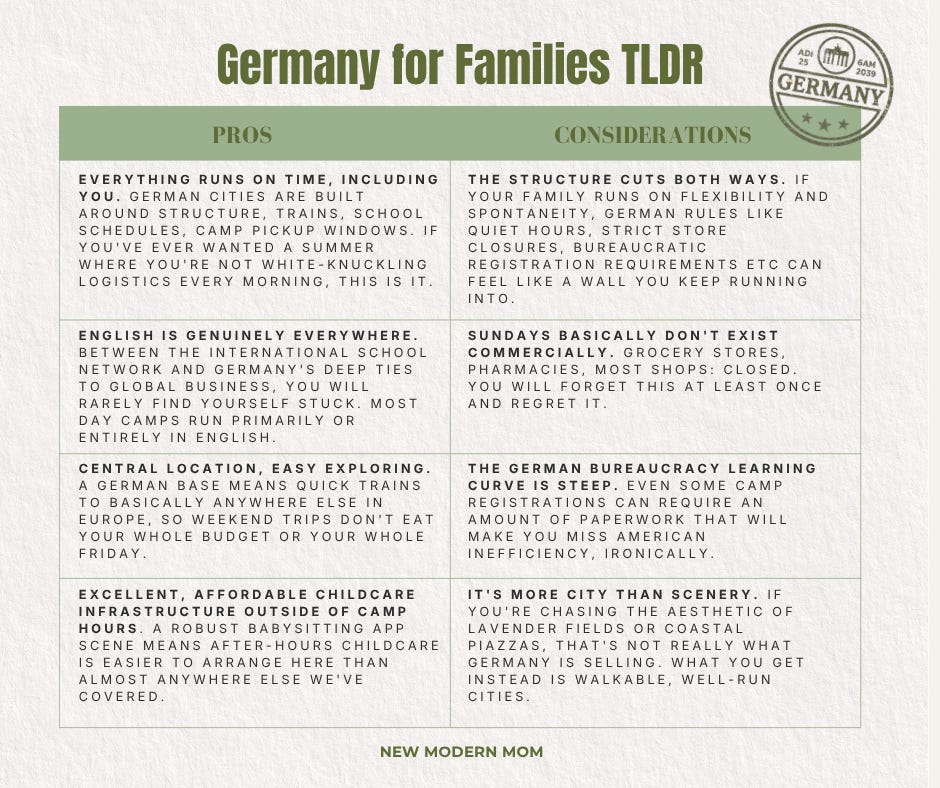
We’re picking this series back up with Germany. It’s less romanticized than Spain or Italy, less discussed than the usual European summer hotspots, but its moderate temperatures and city energy might be exactly what you are craving. Germany doesn’t ask you to figure it out as you go. It hands you a schedule, a system, and a really excellent bakery on the corner, and lets you build your summer around all three.
Logistics: Getting There & Staying There
Ease of Getting There:
Your city choice dictates your entry point:
Berlin: fly into Berlin Brandenburg (BER)
Frankfurt: fly into Frankfurt (FRA), one of the busiest hubs in Europe and often the cheapest transatlantic fare
Munich: fly into Munich (MUC)
Hamburg: fly into Hamburg (HAM)
Frankfurt and Munich both run frequent direct flights from major U.S. East Coast and even some West Coast cities. Berlin and Hamburg may require a connection through Frankfurt, Munich, or another European hub depending on your origin city,
The commute from the airport:
All four cities have excellent train or S-Bahn connections directly from the airport into the city center, typically 25–45 minutes depending on where you land relative to where you’re staying
Getting Around: Stroller vs. Scooter Realism
The stroller: German cities are stroller-friendly in the way you’d hope. Lots of wide sidewalks, curb cuts, and elevators in most train stations (though not universally, so check ahead if you’re relying on one). Bring something sturdy but not oversized; cobblestones exist in older neighborhoods, especially in Berlin
The scooter: Kid scooters are everywhere here too, though not with quite the religious devotion you’ll find somewhere like Switzerland. Bikes are the bigger cultural fixture. If your kids are old enough, a rental or borrowed bike opens up a lot of the city, especially in bike-obsessed Berlin and Munich.
Is a Car Necessary?
No, and in most cases it’s actively a liability. Berlin, Frankfurt, Munich, and Hamburg all run on excellent, extensive public transit that actually show up when they say they will. Parking is expensive and often restricted to residents. Unless you’re planning day trips deep into the countryside on a regular basis, skip the car entirely.
Housing:
Berlin Rent: Family-sized 2–3 bedroom apartments in central, camp-friendly neighborhoods run roughly $2,800–$4,800/month in July, making it one of the more accessible major-city options on this list.
Frankfurt Rent: Expect $3,200–$5,500/month for a comparable family apartment, slightly higher given the concentration of corporate housing demand.
Munich Rent: The most expensive of the four, with family apartments running $4,000–$7,000/month. Munich has some of the highest rents in the country.
Hamburg Rent: A reasonable middle ground at $3,000–$5,000/month, with the added bonus of being near water.
The “American Reality” Check:
Air Conditioning: Still mostly absent, though slightly more common than a few years ago as summers heat up. Ask specifically when booking a rental, and don’t assume. A listing showing a “cooling fan” in photos is not the same as A/C.
Laundry: Most apartments have an in-unit washer, but dryers are far less standard; a lot of German households air-dry laundry on a rack or a shared line, even in cities.
The Weather: What to Expect in July
Berlin: Warm and mostly dry, typically 70°F–82°F during the day, with long daylight hours. Sunset doesn’t happen until closer to 9:30pm.
Frankfurt: Slightly warmer and more humid than Berlin, often in the mid-70s to mid-80s, with the occasional summer thunderstorm rolling through in the evening.
Munich: Similar range to Frankfurt, but with the Alps close enough that afternoon storms are more common. Pack a light rain layer even on sunny mornings.
Hamburg: The coolest of the four by a noticeable margin, usually 65°F–75°F, with more cloud cover and a breeze off the water. Bring a real jacket even in summer.
The German Food Scene & Typical Schedule
What to Eat:
Currywurst: Berlin’s iconic street food — sliced sausage doused in curry ketchup, served with fries. Not fancy, extremely satisfying, and a genuine cultural institution.
Spargel (White Asparagus): A springtime-into-early-summer obsession across the country, served simply with hollandaise, ham, and potatoes. If you catch the tail end of the season, don’t skip it.
Döner Kebab: Technically Turkish-German, but functionally a national food at this point, especially in Berlin, which claims to have invented the modern döner sandwich.
Weisswurst: A Munich and Bavarian staple — a mild white sausage traditionally eaten before noon with sweet mustard and a pretzel, ideally with a beer.
Kaffee und Kuchen: The mid-afternoon coffee-and-cake ritual that shows up everywhere, from bakeries to family kitchens, and is worth building into your own daily rhythm.
Typical Eating Schedule:
Lunch (12:00pm–1:30pm): The main meal of the day in a lot of German households, often warm and substantial.
Kaffee und Kuchen (3:00pm–4:30pm): A genuinely built-in afternoon pause — coffee, cake, and a break, often timed right around camp pickup.
Dinner (6:30pm–8:00pm): Earlier and lighter than lunch, frequently a cold spread of bread, cheese, and cold cuts (Abendbrot) rather than a full cooked meal — a nice, low-effort option on a summer evening.
Things to Do With Kids
Zoo Berlin (Berlin): One of the oldest and most species-diverse zoos in the world, right in the middle of the city, easily a half-day outing.
Deutsches Museum (Munich): A massive, deeply hands-on science and technology museum. There are mine tunnels, cockpit simulators, and enough interactive exhibits to fill an entire day.
Miniatur Wunderland (Hamburg): The world’s largest model railway exhibit, with an airport that has planes that actually “take off.” Genuinely mesmerizing for kids and adults alike.
Palmengarten (Frankfurt): A sprawling botanical garden with a playground, tropical greenhouses, and enough open space for kids to run off camp-day energy.
Europa-Park (near Frankfurt/Stuttgart): Germany’s answer to Disney, a full-scale theme park with country-themed zones. Worth the day trip if your kids are ride-age.
Legoland Deutschland (near Munich): A reliable, well-run option for younger kids, about an hour outside the city.
Things to Do Without Kids
Vabali Spa (Berlin): A serene, adults-oriented thermal spa and sauna complex tucked into the city. It’s an easy antidote to a full week of camp logistics.
Rheingau Wine Region Day Trip (Frankfurt): A short train ride into rolling vineyards along the Rhine, with tastings and terrace lunches overlooking the river.
English Garden Beer Garden Evening (Munich): Grab a table at one of the classic beer gardens in Munich’s massive English Garden park and settle in for the evening. A sacred Munich ritual.
Elbphilharmonie (Hamburg): Catch a concert at Hamburg’s striking waterfront concert hall, even if it’s just to see the building and the harbor views from the plaza.
Museum Island (Berlin): A full evening (or several) of world-class art and history museums clustered on a single island in the Spree.
Städel Museum (Frankfurt): A stellar fine arts collection along the riverside “Museumsufer,” ideal for a quiet afternoon without a stroller in tow.
Local Support
Betreut.de: Germany’s largest platform for finding babysitters, nannies, and au pairs, with a solid base of English-speaking caregivers in the major cities.
Care.com Germany: A reliable option in Berlin, Frankfurt, and Munich specifically, with reviews and background-check features similar to the U.S. platform.
Average Rates: Expect to pay roughly €12–€18/hour (about $13–$19 USD) for a babysitter

The Germany Summer Camp List
A quick note on how to read what’s below: Your base determines your camp options, not the other way around. Pick the region that fits your family’s summer first. Then pick the camp.
The full list of camps with ages, dates, and pricing, is below for paid subscribers.